Home for almost a week
Well, its been 5+ days since the kids arrived home, and so far things are going quite well. They both seem very happy with the house, and enjoy racing around, climbing staircases, playing with light switches and finding all the nooks and crannies. Vika absolutely loves both dogs. Diana likes Anya and has a love-fear relationship with Tango. She loves him when he is behaving, but doesn't like being chased - this scares her. We try to explain that if she doesn't run (especially on all fours!) and make girl giggly scared elated squeaky noises, Tango will not consider her a big animated chew toy, run after her and grab onto her clothing for a game of tug.
Now home, much of the idle time activity has changed from coloring books to the doll house, as well as playing with the dogs. Still, we find as parents we are listening to when it is too quiet - that's when the trouble begins for sure!
And then there is food - it is absolutely amazing how much food a small, 48 pound kid can eat. I sometimes wonder if she eats 2% of her body mass every day! Bottomless pit. Well, as we say with Tango - kids are but little walking chemical factories, that change food into kid (OK, and some waste products).
Only one major meltdown so far, and I don't have to tell anyone who. Diana tends to, err, be a bit defiant at times, especially to "come here" requests. To her, this is a big game, filled with giggling, and she KNOWS we don't enjoy said game. When this happens, the poor parent is given two choices - ignore it, or go and get her. And if you get her, you better hold on, 'cause if you let go she'll run away (and lock a few doors, or crawl under the bed, and increase her mass several fold). Its soft of like getting a kid attached to a large rubber band that leads, oh, under the crawl space somewhere - let go and zzzzzzip plop - she is gone. And no, we're not into just walloping her, tempting as it may be (we leave that to her sister, ha ha).
If, after returning said kid to where she was supposed to come in the first place, you want her to stay there, you start the wrestling match. Per the attachment books (we don't know if there is an attachment problem, or if she's just being a 6 year old - remember, we're clueless on anyone younger than 17 years old!), we hold her tight and close to us ("a "time in"), until she stops squirming....
.... or so the theory goes. In the past, we always gave up in the end. This time we decided to see what happens when we persist. Well, we got about a 15 minute squirmally wormally session, and then (possibly triggered by carrying her to her bed for a much-needed afternoon nap), she added in the crying rinse cycle with occasional punctuations of nose blowing for creative effect. After about 30+ minutes of this (the entire time we are talking to her, reassuring her we love her, etc), G finally put her in a shallow warm bathtub (cloths and all). She washed her, then toweled her down for 30 minutes, etc - she cried some more, then finally quieted down. Since the whole thing was about "if you will be still for 3 minutes in my arms, Chuck will take you to the park", I then did just that - almost 2 hours after our original planned departure.
Today we went to the lake. While I raced four races, the kids swam much of the time, until they are legitimate blue-lipped kids (yes, it really happens). They both loved it. Normal kids for the afternoon.
Next adventure, due this week - trying to formally TEACH them something!
Sunday, August 03, 2008

Monday, July 28, 2008
The need for routine
One of the more recurrent themes you hear when you read about adopting kids that have spent time in an orphanage is the need to maintain routine. And, living in a foreign city with a random schedule revolving around embassy interviews, etc, we have not been doing a very good job.
It is said that kids have clocks in their stomachs. Of this we have a mixed experience, but something happened the other day that was funny at the time and so worth relating.
It was Friday, and our fixed schedule was to have an interview at the US Embassy at 2 pm. The kids were up by 9:30 (our standard time right now, they need lots of sleep and we need C&G time), and we ate breakfast (zaftrak) at around 10. We then at an early lunch for us at 12:30 pm, instead of our normal 2:30 pm. We went to our interview, which took longer than expected, getting out at around 3:30. From there we proceeded with out plan, and arrived at the Moscow Zoo around 4. Here we wandered around (complete with ice cream at 5:30), getting out at 7:30 or so. Our "normal" dinner time has been around 8:30, and we had nothing prepared, so for dinner we opted for street food, which in was pizza and juice in this case. We then did the Metro and walked home, arriving around 8:30. Diana set the table for breakfast the next day (she specifically said zaftrak), and we then proceeded to bathe the kids and watch the second half of a movie. Then time for bed - 10:00, about our standard bedtime. We told them the equivelent of "ok kids, time to get into bed", and we got an surprised face on Vika, who looked seriously at Mom and said, in Russian, "A, uzhin?", which literally translates to "but.... Dinner?". So dinner it was! The kids ate PILES of leftovers, and then slept like rocks.
One of the more recurrent themes you hear when you read about adopting kids that have spent time in an orphanage is the need to maintain routine. And, living in a foreign city with a random schedule revolving around embassy interviews, etc, we have not been doing a very good job.
It is said that kids have clocks in their stomachs. Of this we have a mixed experience, but something happened the other day that was funny at the time and so worth relating.
It was Friday, and our fixed schedule was to have an interview at the US Embassy at 2 pm. The kids were up by 9:30 (our standard time right now, they need lots of sleep and we need C&G time), and we ate breakfast (zaftrak) at around 10. We then at an early lunch for us at 12:30 pm, instead of our normal 2:30 pm. We went to our interview, which took longer than expected, getting out at around 3:30. From there we proceeded with out plan, and arrived at the Moscow Zoo around 4. Here we wandered around (complete with ice cream at 5:30), getting out at 7:30 or so. Our "normal" dinner time has been around 8:30, and we had nothing prepared, so for dinner we opted for street food, which in was pizza and juice in this case. We then did the Metro and walked home, arriving around 8:30. Diana set the table for breakfast the next day (she specifically said zaftrak), and we then proceeded to bathe the kids and watch the second half of a movie. Then time for bed - 10:00, about our standard bedtime. We told them the equivelent of "ok kids, time to get into bed", and we got an surprised face on Vika, who looked seriously at Mom and said, in Russian, "A, uzhin?", which literally translates to "but.... Dinner?". So dinner it was! The kids ate PILES of leftovers, and then slept like rocks.
Impressions of the kids
Both Vika and Diana have very different personalities. True, not knowing Russian, I am a bit challenged in determining their exact nature, but the trend seems clear.
Diana, at six+ years old, is not only the most curious of the two, but is also what parents nicely call "a bundle of energy" - someone whose "child care kit" may have to contain a leash, horse blinders and perhaps some duct tape. She is always getting into trouble, taunting and occasionally defying us, but is very sweet. She is really into sharing food (learned at the orphanage?), and will take anything she is given and make sure everyone has a share (if they want it or not). She is continually talking to either herself or someone else, and is by far the most outgoing of the two.
Vika, at 10+ years old, is a considerably quieter, more reserved girl. She has had a long, hard life, and it shows. Shy yes, but very warm and kindhearted. She looks out for her younger sister, is rarely defiant (that will come, we're sure!), and is clearly trying to make sense of this whole experience she is having. A rather small kid, she doesn't fit in with the 10 year-olds, yet in a few other ways, is older than her years, having to care for all of her siblings since an early age. Vika is a child we are going to have to love, love lots, teach, and watch her grow into her age. She is an easy child to love, though, and we look forward to it.
There are some interesting surprises we have had as a result of their orphanage training. First, for both kiddos, everything has its place, and there is a strong concept of putting things away after they are done with them. They also automatically make their beds after waking up (how long will THAT last), and recently, after being taught to set the table, Diana just started insisting that the table be set for breakfast the next day before going to bed.
Welcome to our family, Vika and Diana!
Both Vika and Diana have very different personalities. True, not knowing Russian, I am a bit challenged in determining their exact nature, but the trend seems clear.
Diana, at six+ years old, is not only the most curious of the two, but is also what parents nicely call "a bundle of energy" - someone whose "child care kit" may have to contain a leash, horse blinders and perhaps some duct tape. She is always getting into trouble, taunting and occasionally defying us, but is very sweet. She is really into sharing food (learned at the orphanage?), and will take anything she is given and make sure everyone has a share (if they want it or not). She is continually talking to either herself or someone else, and is by far the most outgoing of the two.
Vika, at 10+ years old, is a considerably quieter, more reserved girl. She has had a long, hard life, and it shows. Shy yes, but very warm and kindhearted. She looks out for her younger sister, is rarely defiant (that will come, we're sure!), and is clearly trying to make sense of this whole experience she is having. A rather small kid, she doesn't fit in with the 10 year-olds, yet in a few other ways, is older than her years, having to care for all of her siblings since an early age. Vika is a child we are going to have to love, love lots, teach, and watch her grow into her age. She is an easy child to love, though, and we look forward to it.
There are some interesting surprises we have had as a result of their orphanage training. First, for both kiddos, everything has its place, and there is a strong concept of putting things away after they are done with them. They also automatically make their beds after waking up (how long will THAT last), and recently, after being taught to set the table, Diana just started insisting that the table be set for breakfast the next day before going to bed.
Welcome to our family, Vika and Diana!
Sunday, July 27, 2008
Back online - now with kids to distract me
OK, a long time has passed since last posting, but it was due to not being able to get online. Here's what's been happening:
Since we left our heroes (ha ha), we were waiting for court -- in the end, everything went according to plan. It is an interesting, albeit somewhat repetitive process. The proceedings take place over two days, and are conducted in Russian, of course, with a simultaneous translator tell us what is being said and translating our responses. The first day is a hearing between the judge, ourselves, our interpreter, lawyer, and representatives of the Ministry of Education and the two orphanages. For most of this session, the judge asks each of us questions, which we then answer. They are pretty standard ones, and we are briefed with the "proper" answers. But still, like any test, not knowing all the questions, and standing in a formal court setting can unnerve anyone - and we were unnerved. Several of the questions we were asked in the 1 1/2 hour session were:
Why are you choosing to adopt kids? Why not adopt from the US? Why Russia - what's with that?
What rights will the children have once adopted?
Do you get paid by your government to adopt the kids?
Are you adopting them to harvest their organs (just kidding... )
Your kids will certainly misbehave. How do you intend to discipline them? Do you believe in physical punishment?
What religion will you raise them (if any)? What if they want to go to the Russian Orthodox church? (I got to field this one...)
What is your understanding of the physical and mental condition of these kids?
How will you school them? What is the plan?
Does the school have special classes for kids who don't speak Russian?
Does the school provide psychologist and speech therapy?
The second day was just like the first, except this time the judge wore formal black robes, and a "prosecutor" and several other representatives were added behind us. Vika come to the courthouse because she was given the option to see us, but was not allowed in the courtroom. We started with the same question session (many of the same questions, plus some new ones), cross examinations, and then reports and cross examinations from each of the representatives. Each told their own story about their impressions of our qualifications, interactions with the kids, and recommendations. Luckily for us, everyone recommended the granting of the adoption as being in the kids best interest. Finally, there was a long summary by the judge of each of the 162 pages of our court dossier (painfully compiled by myself in the last three months) - complete with interpretation. This was then followed by a short dismissal, a nervous 10 minute wait, and then the ruling by the judge to sustain the adoption. YaY!
This is followed by a mandatory 10 day waiting period. At first we thought this was a period during which others could protest the adoption, but we were misinformed. Instead, it is a period during which we were allowed to change our minds. Since we didn't go through all this for nothing, we did not intend to do so (although we joked about it a dozen or so times). No, for us the 10 day period was a great chance to visit the rest of our family, i.e. our students, in Novgorod. So, we flew from Stavropol to Moscow, then took an overnight train from there to Novgorod. Here we visited Masha and Nina for four days, and then took the bus to Okulovka (an area rather like the Adirondacks, without the high mountains), where Natasha's family was vacationing in a rented cottage. There we stayed for four more days of good relaxation and visiting. After a Saturday midnight train departure, we slept until the train arrived in Moscow at 4:20 am on Sunday morning.
What a pain - tonce the train arrives in the wee hours of the morning (although the sun was rising in this high-latitude location), you can't sleep "extra" on the train, and the Metro doesn't open until 6 am. So you wander around dazed and confused. Eventually the metro opened, and we we went to Lera's - Lera and Alexander have been very kind and lent us their apartment! There we slept, stocked the 'fridge (although Lera had already left it stocked, as it happens) then got on a plane back to Stavropol.
Monday was gotcha day. It started out like any of the other 6 days when we visited. Our driver arrived at 9:30 am, and we started the hour-long drive to Konstantinofskya, where Vika's orphanage was. We had a standard visit, but this time there was a difference - when we got in the van to leave, Vika got to follow us! Happy Vika! From there we drove back to Stavropol where we picked up Diana. Then, a delivery to our hotel and there we were - instant parents! So we started our life, and the next day did paperwork in Stavropol - getting birth certificates and passports for the kids. (we already had airline tickets).
The next morning we left early to fly to Moscow - the kids first airplane flight, very exciting. We then moved into Lera's apartment, and began our temporary life for the following week. I won't waste words on a day-to-day chronology. In general there are four paperwork steps to accomplish - first, a medical exam for the kids (their third since admission to the orphanage) , second, submission of documents to the US embassy, third, an "interview" the following day at same embassy (which gets us formal kid citizenship on US landing permission and a travel visa) and a final step where the kids are registered in the Russian consulate (since they are also Russian citizens, and will be for life).
When we were in the US embassy awaiting our interview, there were probably 10 other adoptive families waiting the same day. And sure enough, it is true - most everyone adopts 18 month old infants (and of those mostly boys) - we were the only parents with older kids.
Sure, there are some very good reasons to adopt infants. But with older adoptive kids, you get some interesting fun which is really enjoyable. Since most of the life experiences we take for granted are totally new to both Diana and Vika, we sort of get our first 5 years of parenthood (so far without the diapers - FEATURE), in concentrated form in a week. Let's see, here is a very partial list of new "first" things, in approximate order: Elevator, air conditioning, pedestrian underpass, grocery store, airplane, loft beds, computers, escalator, trains, metro, zoo, shopping malls, tall buildings with windows (looking out over Moscow), etc. The moments of such discovery are priceless, as I'm sure any parent of small children can attest.
OK, a long time has passed since last posting, but it was due to not being able to get online. Here's what's been happening:
Since we left our heroes (ha ha), we were waiting for court -- in the end, everything went according to plan. It is an interesting, albeit somewhat repetitive process. The proceedings take place over two days, and are conducted in Russian, of course, with a simultaneous translator tell us what is being said and translating our responses. The first day is a hearing between the judge, ourselves, our interpreter, lawyer, and representatives of the Ministry of Education and the two orphanages. For most of this session, the judge asks each of us questions, which we then answer. They are pretty standard ones, and we are briefed with the "proper" answers. But still, like any test, not knowing all the questions, and standing in a formal court setting can unnerve anyone - and we were unnerved. Several of the questions we were asked in the 1 1/2 hour session were:
Why are you choosing to adopt kids? Why not adopt from the US? Why Russia - what's with that?
What rights will the children have once adopted?
Do you get paid by your government to adopt the kids?
Are you adopting them to harvest their organs (just kidding... )
Your kids will certainly misbehave. How do you intend to discipline them? Do you believe in physical punishment?
What religion will you raise them (if any)? What if they want to go to the Russian Orthodox church? (I got to field this one...)
What is your understanding of the physical and mental condition of these kids?
How will you school them? What is the plan?
Does the school have special classes for kids who don't speak Russian?
Does the school provide psychologist and speech therapy?
The second day was just like the first, except this time the judge wore formal black robes, and a "prosecutor" and several other representatives were added behind us. Vika come to the courthouse because she was given the option to see us, but was not allowed in the courtroom. We started with the same question session (many of the same questions, plus some new ones), cross examinations, and then reports and cross examinations from each of the representatives. Each told their own story about their impressions of our qualifications, interactions with the kids, and recommendations. Luckily for us, everyone recommended the granting of the adoption as being in the kids best interest. Finally, there was a long summary by the judge of each of the 162 pages of our court dossier (painfully compiled by myself in the last three months) - complete with interpretation. This was then followed by a short dismissal, a nervous 10 minute wait, and then the ruling by the judge to sustain the adoption. YaY!
This is followed by a mandatory 10 day waiting period. At first we thought this was a period during which others could protest the adoption, but we were misinformed. Instead, it is a period during which we were allowed to change our minds. Since we didn't go through all this for nothing, we did not intend to do so (although we joked about it a dozen or so times). No, for us the 10 day period was a great chance to visit the rest of our family, i.e. our students, in Novgorod. So, we flew from Stavropol to Moscow, then took an overnight train from there to Novgorod. Here we visited Masha and Nina for four days, and then took the bus to Okulovka (an area rather like the Adirondacks, without the high mountains), where Natasha's family was vacationing in a rented cottage. There we stayed for four more days of good relaxation and visiting. After a Saturday midnight train departure, we slept until the train arrived in Moscow at 4:20 am on Sunday morning.
What a pain - tonce the train arrives in the wee hours of the morning (although the sun was rising in this high-latitude location), you can't sleep "extra" on the train, and the Metro doesn't open until 6 am. So you wander around dazed and confused. Eventually the metro opened, and we we went to Lera's - Lera and Alexander have been very kind and lent us their apartment! There we slept, stocked the 'fridge (although Lera had already left it stocked, as it happens) then got on a plane back to Stavropol.
Monday was gotcha day. It started out like any of the other 6 days when we visited. Our driver arrived at 9:30 am, and we started the hour-long drive to Konstantinofskya, where Vika's orphanage was. We had a standard visit, but this time there was a difference - when we got in the van to leave, Vika got to follow us! Happy Vika! From there we drove back to Stavropol where we picked up Diana. Then, a delivery to our hotel and there we were - instant parents! So we started our life, and the next day did paperwork in Stavropol - getting birth certificates and passports for the kids. (we already had airline tickets).
The next morning we left early to fly to Moscow - the kids first airplane flight, very exciting. We then moved into Lera's apartment, and began our temporary life for the following week. I won't waste words on a day-to-day chronology. In general there are four paperwork steps to accomplish - first, a medical exam for the kids (their third since admission to the orphanage) , second, submission of documents to the US embassy, third, an "interview" the following day at same embassy (which gets us formal kid citizenship on US landing permission and a travel visa) and a final step where the kids are registered in the Russian consulate (since they are also Russian citizens, and will be for life).
When we were in the US embassy awaiting our interview, there were probably 10 other adoptive families waiting the same day. And sure enough, it is true - most everyone adopts 18 month old infants (and of those mostly boys) - we were the only parents with older kids.
Sure, there are some very good reasons to adopt infants. But with older adoptive kids, you get some interesting fun which is really enjoyable. Since most of the life experiences we take for granted are totally new to both Diana and Vika, we sort of get our first 5 years of parenthood (so far without the diapers - FEATURE), in concentrated form in a week. Let's see, here is a very partial list of new "first" things, in approximate order: Elevator, air conditioning, pedestrian underpass, grocery store, airplane, loft beds, computers, escalator, trains, metro, zoo, shopping malls, tall buildings with windows (looking out over Moscow), etc. The moments of such discovery are priceless, as I'm sure any parent of small children can attest.
Tuesday, July 08, 2008
What's been happening for the last 6 months....
Well, here I sit in a hotel room in Stavropol, Russia - and on my second visit to Stavropol in three months. In January, I didn't even know there was such a city, and only vaguely knew about exactly where the region it is located in (the Caucasus) could be found. A lot has happened in these last six months. In some ways, you could say less has happened, if you consider "happening" to be activity from a variety of areas. But in one area specifically, there has been a frenzy of focused, obsessive activity.
Adoption. Ten years ago we would have never considered it, and would not even be capable of saying the word. Five years ago we briefly discussed the topic and quickly wrote it off as too risky a thing to even consider. Early this January, we both found ourselves joking about it with our friends - "Oh yeah, and Chuck wonders when the ten-year old is going to show up" - and then comparing notes and (totally surprisingly to both of us) agreeing to do it. What happened in between?
Well, you could say (in order) Natasha, Alicia, Tanya, Tasha, Masha and Nina happened. These people, all from a different country (Russia) and the same region (Novgorod), enriched our lives, taught us to love, taught us to learn and caused us to look at ourselves in ways we never would have guessed. They form the core of our family, and make us feel soooo very rich to know them. Today, they out there, building their lives, each in their own special way and phase of life. It is an awesome thing to watch happen.
The strength this whole experience as well as our becoming more willing to leave "the comfort zone" has given us is the faith to try being "real" parents to two young girls, from the same country, same culture, but a very different background. In two weeks, we will be parents to Diana, a 6 1/2 year of pile of energy, and Vika, a quiet 10 1/2 year old ready to build a new life with us. May the collective strength of the universe and whatever else is out there help us do our job well.
I will save everyone the boring logistics on doing an international adoption. Not only is it not for the feint of heart, it is a tremendous, time consuming hassle that words cannot possibly describe and few who have not been involved in adoption can appreciate. After doing our research for a month, we applied to a program in the end of January, and this began the paperwork. After literally 2 months of continuous paperwork, interviews and hassles, we received our first referral (well really the second, but we won't go there), and prepared to travel to meet these girls in mid-April. We then travels, visited each three times, and accepted the referrals. Then back to another 6 weeks of paperwork and several weeks of further waiting before we were given a "court date" - this is where things get serious.
Before the first trip was taken, the adoption process seemed almost a theoretical, disassociated thing - lot of work, reading, researching and fright from the possible outcomes. Then you see the girls, and the fright is replaced with elation and a different sort of fear - how can we possibly get our lives into shape and make a convincing family with a convincing home and traditions?
Then you finally complete that final dossier - and wait, and wait, and wait. They say this is the hardest of all, and sure enough there is truth to it. You literally do not know if you will be called in a week, in 4 months (there's that feared "summer vacation" problem, where Russia disappears during mid-July to August), or never if Russia were to decide stop doing external adoption at all. You worry about things, but at least to me it was date and program related worry.
Then you get that court date (in our case, we got about 13 days notice, about average). Suddenly, after arranging the tickets and last minute paperwork, you are really for the first time faced with near-certainty, that when you return from your trip, nothing will be the same again. Never. Its a feeling a bit like a roller coaster - you look at it, and decide to try it. You then stand in a boring line for a while. Then you finally start climbing the last flight of stairs to the top, and realize that once this thing takes off, you can yell all you want, but the ride will not stop. You just have to have faith that you will survive in one piece.
That's were we are about now as I write this.
Today we visited the kids for the first time since seeing them two months ago. They trusted we would return after those visits long ago, and were relieved and happy when they saw our smiling faces. They trusted us, now it is time for us to trust ourselves, and embrace their happy faces and hopes. We are now happy but scared parents-to-be. Tomorrow will be our first of two court days. That's the point in the ride where they have let you onto the ride platform and wait for the next roller-coaster cars to arrive. Then a ten day waiting period (mandatory wait), the judge declares them yours, and you're off.
Whhhhheeeeeeee!!!!
Tuesday, January 08, 2008
WARM!
Today is one of those days where the world forgets that it is January, and we get several days of Spring weather. All the snow melts, the world is wet, and then it starts to dry. Result - today is a wonderful day! The temperature is about 20C (68F) out today, and I just got back from a walk without jacket. Last night I ran with lightweight tights, and I was TOO HOT. Not bad for the 7th of January!
Of course, all things will come to an end. But that is OK, mini-vacation had, now back to reality.
Today is one of those days where the world forgets that it is January, and we get several days of Spring weather. All the snow melts, the world is wet, and then it starts to dry. Result - today is a wonderful day! The temperature is about 20C (68F) out today, and I just got back from a walk without jacket. Last night I ran with lightweight tights, and I was TOO HOT. Not bad for the 7th of January!
Of course, all things will come to an end. But that is OK, mini-vacation had, now back to reality.
The hot tub is fixed! The hot tub is fixed!
This may not be exciting for anyone else, but for me it is! As many know, I love my Softub hot tub. But over a year ago, it broke - the motor stopped working.
Well, after several lesser fix attempts (involving two filling / empty cycles in the process), I finally replaced the motor / pump assembly. Then put it back together, filled it with water, and.... it slowly leaked :-(
Next I replaced the gaskets - filled it back up, and it still leaked.
Finally I consented to having the hot tub store replace the liner - it apparently had grown old and developed some microcracks. I got it back about 2 weeks ago, filled it, and..... the motor didn't work!
OK, drained it, diagnosed it, and found that it was a problem with the ground-fault breaker. Fixed that, filled it and now it is fine (or at least as best I can tell).
Yesterday I used it 3 times! Happy Chuck! Happy ending!
This may not be exciting for anyone else, but for me it is! As many know, I love my Softub hot tub. But over a year ago, it broke - the motor stopped working.
Well, after several lesser fix attempts (involving two filling / empty cycles in the process), I finally replaced the motor / pump assembly. Then put it back together, filled it with water, and.... it slowly leaked :-(
Next I replaced the gaskets - filled it back up, and it still leaked.
Finally I consented to having the hot tub store replace the liner - it apparently had grown old and developed some microcracks. I got it back about 2 weeks ago, filled it, and..... the motor didn't work!
OK, drained it, diagnosed it, and found that it was a problem with the ground-fault breaker. Fixed that, filled it and now it is fine (or at least as best I can tell).
Yesterday I used it 3 times! Happy Chuck! Happy ending!
Tuesday, January 01, 2008
Photographic color rendition under varying illuminants
Sorry once again for the non-fun blog. This will stop soon, promise...
I always wanted to do this experiment - take a sample, photograph it under several different light sources, correct the white balance for each, and once this is done, see how much different things look in the corrected photographs. From a practical standpoint, this translates to "how important is it to use daylight to photograph art or a still life?".
I am going to skip the discussion of color rendering index (CRI) and other related topics - if you don't know what they are, you probably aren't reading this anyways... Some day I'll perhaps provide at least some references. Meanwhile, on to the experiment.
G, my watercolor paint swatch obsessive wife, unwittingly provided a color test target - full strength tube watercolor paints. My goal was to take three nearly identical photographs, varying only the light source.
The first light source is the reference standard - mid-day daylight, in this case natural light under a cloudy sky (no direct sunlight of the target). The second source was a compact fluorescent light fixture (sorry, don't know the model) with a specified 5000K, 91 CRI 70W bulb (actually three 23 w. bulbs combined). Finally, I used a quartz halogen source. For this, I started with a halogen flood lamp, but didn't like the light distribution, instead using two 75w halogen floor lamp fixtures.
The targets were photographed using a Nikon D80 at f8, 50 mm, using Nikon RAW mode. Once the images were captured, Adobe Camera Raw was used to convert the images to Adobe RGB files. The following procedure was used for each image:
First, the reference daylight picture:

Next, the Halogen picture:


Sorry once again for the non-fun blog. This will stop soon, promise...
I always wanted to do this experiment - take a sample, photograph it under several different light sources, correct the white balance for each, and once this is done, see how much different things look in the corrected photographs. From a practical standpoint, this translates to "how important is it to use daylight to photograph art or a still life?".
I am going to skip the discussion of color rendering index (CRI) and other related topics - if you don't know what they are, you probably aren't reading this anyways... Some day I'll perhaps provide at least some references. Meanwhile, on to the experiment.
G, my watercolor paint swatch obsessive wife, unwittingly provided a color test target - full strength tube watercolor paints. My goal was to take three nearly identical photographs, varying only the light source.
The first light source is the reference standard - mid-day daylight, in this case natural light under a cloudy sky (no direct sunlight of the target). The second source was a compact fluorescent light fixture (sorry, don't know the model) with a specified 5000K, 91 CRI 70W bulb (actually three 23 w. bulbs combined). Finally, I used a quartz halogen source. For this, I started with a halogen flood lamp, but didn't like the light distribution, instead using two 75w halogen floor lamp fixtures.
The targets were photographed using a Nikon D80 at f8, 50 mm, using Nikon RAW mode. Once the images were captured, Adobe Camera Raw was used to convert the images to Adobe RGB files. The following procedure was used for each image:
- Set the white balance using the white center of the color wheel. This is done by clicking in ACR with the white balance eyedropper.
- Set the exposure (essentially adjusting the histogram) as follows: view in threshold mode, and advance exposure until the first sign of clipping (this always happened in the oranges, but the paper white, interestingly enough...), then back off .05 exposure units.
- Rotate and crop the images so they are approximately the same size.
- Specify a conversion to Adobe RBG (which provides a wider gamut than sRGB). Then, for web viewing, (the picures you will be viewing below), also convert a copy to sRGB mode and save as a separate .jpg.
No other manipulation was done in Photoshop, save adding a text layer to identify the light source. So, here are the three resultant pictures:
First, the reference daylight picture:

Next, the Halogen picture:

Finally, the High color rendering index Fluorescent lamp:

Analysis - lots of thoughts, lots of things to say, no hard conclusions - but those will have to wait for a bit, as it is now time for bed....
Saturday, December 29, 2007
Observations on photographing art and color gamut

Normal people may want to skip this one. It is just a technical note.
Recently I did some experiments on photographing art, in this case watercolors. Unlike "normal" scenes that involve natural things, faces, hedgehogs and dogs, when you start to wander into the area of paints, you can get some pretty intense colors. As part of a larger experiment on understanding how to accurately photograph art, I thought I would investigate some gamut issues.
To do this, I placed two watercolor paintings, a set of "full strength" tube watercolor paint swatches (Daniel Smith, if you need to know) and a grey card in my living room under well lit, cloudy indirect light. The art was photographed with Nikon D80, with a Nikkor 18-200 lens set at 50mm (75 mm eq. for 35mm) at f8 in raw (.nef) mode.
The first time I entered Photoshop camera raw (ACR4), I set the white balance on the illuminated part of the Kodak 18% grey card. This seemed to correspond to a color temperature of 4950 K. The camera's "guess" at the white balance was 5000K. Both of these proved to be too "cool", and this is not unexpected, as normally we think of cloudy as about 6000K. I then set the white balance on the white paper itself. This came in at 5800, which is closer, but (no surprise) rendered the paper as white when in reality it is slightly warm. When I chose 6100K on the slider, the paper color looked about right on the monitor. As it happens, when subsequently printing, this still resulted in a printed color still a bit bluer than the actual paper. But this blog is not about color matching, it is about gamut, so I will stop.
I converted the image into Adobe RGB, 16 bit, and then looked at it in photoshop. I then set up to proof these under a variety of conditions, and looked at where I found out of gamut colors come up. But first, a reminder - even though I am in a wide color space, the camera could have already clipped some colors, and I would have no way of knowing. However, given that in general the printer gamuts are often the most limiting, and given what I found, it seems to me that this was not the case here.
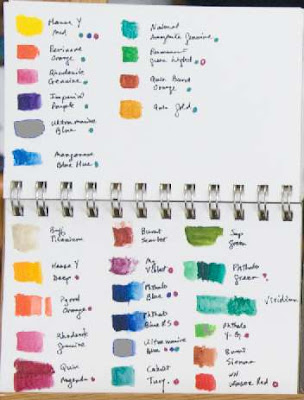
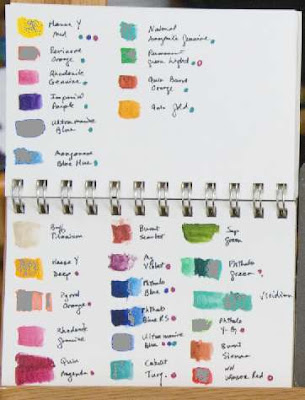
First, I selected an output space of sRGB, and looked at the gamut warnings. As it happens, this space was the most restrictive - it clipped parts (perhaps about 5%) of the watercolor paintings, especially blues and oranges, little bits of the golden wood, and about 20% of the full strength color swatches. Here is the gamut display, with the clipped colors shown as grey patches or dots:

It is also useful to note that since for web display, you render everything in sRGB, so the photo that appears at the top of this blog entry has already been clipped per the areas above - but at the same time, you can look to see that such clipping is not horrible, it just makes them less intense than in real life or when printed on a good printer. Also note that this first picture (and not the clipped gamut demo pictures) is the only one that is color managed properly at all - you can see that the paper itself is not white, but should show slightly warm.
Next, I selected my inkjet printer (HP D7160) with HP Premium plus glossy paper. This left everything unclipped except the full strength ultramarine blue color:
Next, I selected a profile I use for printing at Adorama. They print on Kodak Endura, a professional color print paper, and use the best processing machines out there. Here, there was some moderate clipping, a bit better than sRGB, but not as good as the inkjets:
Finally, I selected the profile from EZPrints (a profile I had downloaded a while ago) - they are also an online printer, and I think (but am not sure) that they offer prints using pigment ink. These can (if they use a 7 or more ink system) produce a somewhat wider gamut. Regardless of which printer they have, there was no gamut clipping in this case.
Normal people may want to skip this one. It is just a technical note.
Recently I did some experiments on photographing art, in this case watercolors. Unlike "normal" scenes that involve natural things, faces, hedgehogs and dogs, when you start to wander into the area of paints, you can get some pretty intense colors. As part of a larger experiment on understanding how to accurately photograph art, I thought I would investigate some gamut issues.
To do this, I placed two watercolor paintings, a set of "full strength" tube watercolor paint swatches (Daniel Smith, if you need to know) and a grey card in my living room under well lit, cloudy indirect light. The art was photographed with Nikon D80, with a Nikkor 18-200 lens set at 50mm (75 mm eq. for 35mm) at f8 in raw (.nef) mode.
The first time I entered Photoshop camera raw (ACR4), I set the white balance on the illuminated part of the Kodak 18% grey card. This seemed to correspond to a color temperature of 4950 K. The camera's "guess" at the white balance was 5000K. Both of these proved to be too "cool", and this is not unexpected, as normally we think of cloudy as about 6000K. I then set the white balance on the white paper itself. This came in at 5800, which is closer, but (no surprise) rendered the paper as white when in reality it is slightly warm. When I chose 6100K on the slider, the paper color looked about right on the monitor. As it happens, when subsequently printing, this still resulted in a printed color still a bit bluer than the actual paper. But this blog is not about color matching, it is about gamut, so I will stop.
I converted the image into Adobe RGB, 16 bit, and then looked at it in photoshop. I then set up to proof these under a variety of conditions, and looked at where I found out of gamut colors come up. But first, a reminder - even though I am in a wide color space, the camera could have already clipped some colors, and I would have no way of knowing. However, given that in general the printer gamuts are often the most limiting, and given what I found, it seems to me that this was not the case here.
First, I selected an output space of sRGB, and looked at the gamut warnings. As it happens, this space was the most restrictive - it clipped parts (perhaps about 5%) of the watercolor paintings, especially blues and oranges, little bits of the golden wood, and about 20% of the full strength color swatches. Here is the gamut display, with the clipped colors shown as grey patches or dots:

It is also useful to note that since for web display, you render everything in sRGB, so the photo that appears at the top of this blog entry has already been clipped per the areas above - but at the same time, you can look to see that such clipping is not horrible, it just makes them less intense than in real life or when printed on a good printer. Also note that this first picture (and not the clipped gamut demo pictures) is the only one that is color managed properly at all - you can see that the paper itself is not white, but should show slightly warm.
Next, I selected my inkjet printer (HP D7160) with HP Premium plus glossy paper. This left everything unclipped except the full strength ultramarine blue color:

Next, I selected a profile I use for printing at Adorama. They print on Kodak Endura, a professional color print paper, and use the best processing machines out there. Here, there was some moderate clipping, a bit better than sRGB, but not as good as the inkjets:

Finally, I selected the profile from EZPrints (a profile I had downloaded a while ago) - they are also an online printer, and I think (but am not sure) that they offer prints using pigment ink. These can (if they use a 7 or more ink system) produce a somewhat wider gamut. Regardless of which printer they have, there was no gamut clipping in this case.
Monday, December 17, 2007
Thursday, December 06, 2007
New "safe" feature - Child-safe caps on Water bottles??????
At our company open-house, I picked up a small container of Polish Spring bottled water to drink, and turned the twist cap. Nothing happened. Turned it again - couldn't figure out how to get it open, even though I have been doing this for years.
I then noticed the label proudly displaying the "Child-safe twist cap!" safety feature. Huh?
My first thought was "why, do they need to protect the kids from accidentally drinking the water? Is water that harmful? I try pushing and turning the cap, the standard way of opening child-proof things - no luck.
Then I notice the entire cap on the bottle is turning. Now I get it. On further reading, The Child safe feature, says "non-removable cap reduces the risk of choking" Yeah. Right. Caps are pretty big things - if this is a risk, there are a whole LOT of things that would have to be eliminated from the world first.
With this, I now know what I need to do - hold the lower cap with my hand, then turn the upper to break an almost-invisible plastic tab. From then on, things worked normally.
Nope, I don't think this has to do at all with child safety. It has to do with preventing people from refilling the bottles - if you can't get the cap off (and you can't!) you can't refill the bottles.
I hope this doesn't catch on....
At our company open-house, I picked up a small container of Polish Spring bottled water to drink, and turned the twist cap. Nothing happened. Turned it again - couldn't figure out how to get it open, even though I have been doing this for years.
I then noticed the label proudly displaying the "Child-safe twist cap!" safety feature. Huh?
My first thought was "why, do they need to protect the kids from accidentally drinking the water? Is water that harmful? I try pushing and turning the cap, the standard way of opening child-proof things - no luck.
Then I notice the entire cap on the bottle is turning. Now I get it. On further reading, The Child safe feature, says "non-removable cap reduces the risk of choking" Yeah. Right. Caps are pretty big things - if this is a risk, there are a whole LOT of things that would have to be eliminated from the world first.
With this, I now know what I need to do - hold the lower cap with my hand, then turn the upper to break an almost-invisible plastic tab. From then on, things worked normally.
Nope, I don't think this has to do at all with child safety. It has to do with preventing people from refilling the bottles - if you can't get the cap off (and you can't!) you can't refill the bottles.
I hope this doesn't catch on....
Saturday, December 01, 2007
A leisurely Sunday
Well, last Sunday, actually. The previous week had been busy. I took Tuesday and Wednesday off from work, giving me a full week free. On Tuesday, we went to visit my mom in Lakewood. She is doing quite well, actually. We returned late at night, and the next day G's mom and brother drove up from NJ for a visit. We had a good Thanksgiving meal on Thursday, Tim treated us to a nice dinner out on Friday, and I cooked dinner on Saturday. Eat, Eat Eat.
On Sunday, we were back to ourselves, just the two of us. We embarked on some causal birding along the Lake Ontario lake shore. Here is a list of what we saw:
Well, last Sunday, actually. The previous week had been busy. I took Tuesday and Wednesday off from work, giving me a full week free. On Tuesday, we went to visit my mom in Lakewood. She is doing quite well, actually. We returned late at night, and the next day G's mom and brother drove up from NJ for a visit. We had a good Thanksgiving meal on Thursday, Tim treated us to a nice dinner out on Friday, and I cooked dinner on Saturday. Eat, Eat Eat.
On Sunday, we were back to ourselves, just the two of us. We embarked on some causal birding along the Lake Ontario lake shore. Here is a list of what we saw:
- Hood Merganser
- Red-breasted merganser
- Ring-billed Gull
- Canada goose
- Mallard
- Herring Gull
- Redhead
- Common Merganser
- Scaup (greater or lesser we do not know)
- Great blue heron
- Black-capped chickadee
- Red-breasted woodpecker
- American crow
- Greater black-backed gull
- American robin
- European starling
- Red-tailed hawk
- House finch
- Mute swan
- Double-crested cormorant
- Mourning dove
Friday, November 16, 2007
Yay!! Hot tub will be fixed soon!
For about the last year, our hot tub has had a slow leak, and as a result we have not been able to use it. Well, I finally got my rear in gear, had them pick it up and diagnose it. They found several small tears in the liner, which is not too surprising, given it is 10 years old. I told them to reskin it (this time the inside will be blue instead of black), in which case we will have a "almost good as new" tub again.
I can hardly wait! Winter is almost here, and I am getting tired of taking baths!
For about the last year, our hot tub has had a slow leak, and as a result we have not been able to use it. Well, I finally got my rear in gear, had them pick it up and diagnose it. They found several small tears in the liner, which is not too surprising, given it is 10 years old. I told them to reskin it (this time the inside will be blue instead of black), in which case we will have a "almost good as new" tub again.
I can hardly wait! Winter is almost here, and I am getting tired of taking baths!
Thursday, November 08, 2007
Finally completed - Chuck "classic" blogs now on this site
The blog you are reading now is not the original blog I had. I changed over from blog-city to blogspot about a year ago, because this site is a bit more progressive and FREE. But for a long time, only the new entries were here. Now I've finally moved the old "classic" entries to this block. Just check out the archive - there are actually some pretty amusing posts there. Hmm was my life more interesting then, or did I just have more time to burn?
Sorry if the formatting and details are not perfect - I just moved the HTML and prayed.
The blog you are reading now is not the original blog I had. I changed over from blog-city to blogspot about a year ago, because this site is a bit more progressive and FREE. But for a long time, only the new entries were here. Now I've finally moved the old "classic" entries to this block. Just check out the archive - there are actually some pretty amusing posts there. Hmm was my life more interesting then, or did I just have more time to burn?
Sorry if the formatting and details are not perfect - I just moved the HTML and prayed.
Wednesday, November 07, 2007
Tuesday, November 06, 2007
The standard Chuck Smoothie
Several years ago David S. introduced me to the concept of a smoothie, sold at the U/R coffee bar place. For him, a smoothie was routinely his complete dinner (don't know where he got his other 2200 calories).
I was always too cheap to buy the things, but David, like many college students, was on a "declining balance" plan, and would have "use it or lose it" money left at the end of the year. With the prospect of free food, I got addicted to one type - the one with just fruit, and no dairy products.
I then started buying them on business trips, where others were paying the tab. I have never been willing to spend my $4.50 for one with my own money. But then, Gwendolyn encouraged me to abandon my reservations about unnecessary household appliances, and buy a blender.
The rest was history...
I have tried a number of variations, with different degrees of precision in measuring ingredients (just don't ask - I have all the lab equipment I need). In the end, I use the rule of thumb method, as follows. This is to make one medium-large (about 500 ml, or 17 oz) black raspberry smoothie. It works like this, and takes very little time:
Several years ago David S. introduced me to the concept of a smoothie, sold at the U/R coffee bar place. For him, a smoothie was routinely his complete dinner (don't know where he got his other 2200 calories).
I was always too cheap to buy the things, but David, like many college students, was on a "declining balance" plan, and would have "use it or lose it" money left at the end of the year. With the prospect of free food, I got addicted to one type - the one with just fruit, and no dairy products.
I then started buying them on business trips, where others were paying the tab. I have never been willing to spend my $4.50 for one with my own money. But then, Gwendolyn encouraged me to abandon my reservations about unnecessary household appliances, and buy a blender.
The rest was history...
I have tried a number of variations, with different degrees of precision in measuring ingredients (just don't ask - I have all the lab equipment I need). In the end, I use the rule of thumb method, as follows. This is to make one medium-large (about 500 ml, or 17 oz) black raspberry smoothie. It works like this, and takes very little time:
- Take the blender jug, and add a combination of frozen black raspberries and frozen red raspberries, until it comes up to the 500 ml mark.
- Add about 60 ml (2 oz) of lemon juice (the normal sour stuff)
- Add about 2 tablespoons (30 ml dry) of either sugar or Splenda
- Add cold water until the water comes just above the surface of the frozen fruit
- Start blending at medium speed - if the blender does not mix properly, add a bit more water.
- Once the frozen chunks are broken up, move to high speed, blend until smooth (about 45 seconds to a minute, usually)
- Sample the mix, if too sour, add some more sugar or Splenda
Saturday, November 03, 2007
Tango's revenge...
I have been sitting down here alone with Tango, obsessing in Photoshop on the computer. The puppy is wandering around. I can't hear him chewing anything, and in this case quiet is good.
He likes to hang around under the desk exploring. Sometimes he sleeps, sometimes he explores - you sort of forget about him if you don't hear him chewing.
Then I hear a beep and my computer screen goes blank. He found the switch to the computer's uninterpretable power supply! Then, a two second pause, another beep, and the computer starts to reboot. Just what I need - Tango has found a new variation on the old-fashion squeak toy - just hit this button and you get a nice beep.
Nice.... NOT!
I have been sitting down here alone with Tango, obsessing in Photoshop on the computer. The puppy is wandering around. I can't hear him chewing anything, and in this case quiet is good.
He likes to hang around under the desk exploring. Sometimes he sleeps, sometimes he explores - you sort of forget about him if you don't hear him chewing.
Then I hear a beep and my computer screen goes blank. He found the switch to the computer's uninterpretable power supply! Then, a two second pause, another beep, and the computer starts to reboot. Just what I need - Tango has found a new variation on the old-fashion squeak toy - just hit this button and you get a nice beep.
Nice.... NOT!
Friday, November 02, 2007

Thursday, November 01, 2007
Interesting volleyball experience
I had one of those eye opening opportunities this evening. On Thursday night, we play pickup volleyball. Usually the two courts self-organize into "better" and "worse", but once both courts fill, you often get a mix. Sometimes this mix (especially "worse" on the "better court") can cause some frustration.
I was playing on the "better" court, and we were having a good game of 5 on 5 - the other court was full with 6 on a team. Then two people walked in, and they couldn't have looked more different. The first was a very American looking guy, probably about 45, 6 foot tall (182 cm), and just didn't look like a volleyball player. With him came a very slight, very Asian looking girl, and 4 foot 10 inches (147 cm) at the tallest. She probably weighted 38 kg at most, and looked somewhere between 16 and 19 - hard to tell. I didn't quite get her name, something like Lana, I think. I later verified that she was his daughter, presumably adopted.
Well, he joined the other team, and Lana joined ours. After a few points, it was clear that this was going to be a problem. He had no volleyball skill, and was sort of randomly moving obstacle just waiting to cause an accident. Lana was different. She was a very directly moving massless particle, fearless, but, well, massless. She would hit the ball, and more likely she would get knocked over herself. She would try landing for the hardest spikes, intercept the ball (which would go careening off into the ceiling) and go rolling over. Her serves were hilarious at first, since she didn't weigh much more than the volleyball. For her first two serves, she tossed the ball, reached up, missed it, and flipped upside down, giggling. And then got up and did it again!
Eventually her Dad dropped out and watched, but she kept playing. And improved. And improved. She quickly learned where to run to intercept the ball. She copied others and learned how to underhand "bump" the ball. After some spectacular and amusing complete misses, she tried to floor spike some balls. We taught her how to set, and she started doing that.
By the end of the night, she was still at the bottom of the hierarchy, but she fit in. Everyone was cheering her on, and her learning curve was very steep. We all invited her back next week, if for no other reason to see what starts happening then. Probably by then she'll be doing floor dives and rolls.
Seriously, though, I really enjoyed watching her learn, watching her figure out the physics so she didn't get knocked over, and her fearlessness. Go girl!
I had one of those eye opening opportunities this evening. On Thursday night, we play pickup volleyball. Usually the two courts self-organize into "better" and "worse", but once both courts fill, you often get a mix. Sometimes this mix (especially "worse" on the "better court") can cause some frustration.
I was playing on the "better" court, and we were having a good game of 5 on 5 - the other court was full with 6 on a team. Then two people walked in, and they couldn't have looked more different. The first was a very American looking guy, probably about 45, 6 foot tall (182 cm), and just didn't look like a volleyball player. With him came a very slight, very Asian looking girl, and 4 foot 10 inches (147 cm) at the tallest. She probably weighted 38 kg at most, and looked somewhere between 16 and 19 - hard to tell. I didn't quite get her name, something like Lana, I think. I later verified that she was his daughter, presumably adopted.
Well, he joined the other team, and Lana joined ours. After a few points, it was clear that this was going to be a problem. He had no volleyball skill, and was sort of randomly moving obstacle just waiting to cause an accident. Lana was different. She was a very directly moving massless particle, fearless, but, well, massless. She would hit the ball, and more likely she would get knocked over herself. She would try landing for the hardest spikes, intercept the ball (which would go careening off into the ceiling) and go rolling over. Her serves were hilarious at first, since she didn't weigh much more than the volleyball. For her first two serves, she tossed the ball, reached up, missed it, and flipped upside down, giggling. And then got up and did it again!
Eventually her Dad dropped out and watched, but she kept playing. And improved. And improved. She quickly learned where to run to intercept the ball. She copied others and learned how to underhand "bump" the ball. After some spectacular and amusing complete misses, she tried to floor spike some balls. We taught her how to set, and she started doing that.
By the end of the night, she was still at the bottom of the hierarchy, but she fit in. Everyone was cheering her on, and her learning curve was very steep. We all invited her back next week, if for no other reason to see what starts happening then. Probably by then she'll be doing floor dives and rolls.
Seriously, though, I really enjoyed watching her learn, watching her figure out the physics so she didn't get knocked over, and her fearlessness. Go girl!
Subscribe to:
Posts (Atom)